
Movements
of the Thumb
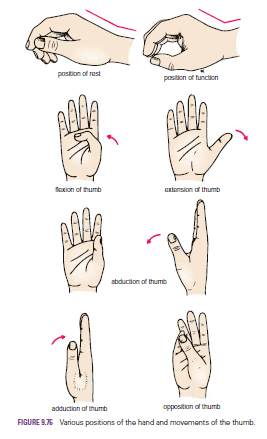
Flexion is the movement of the thumb across the palm in such
a manner as to maintain the plane of the thumbnail at right angles to the plane
of the other fingernails.
The movement takes place between the trapezium and the1st
metacarpal bone, at the metacarpophalangeal and interphalangeal joints. The
muscles producing the movement are the flexor pollicis longus and brevis and
the opponens pollicis.
Extension is the movement of the thumb in a lateral or coronal
plane away from the palm in such a manner as to maintain the plane of the
thumbnail at right angles to the plane of the other fingernails. The movement
takes place between the trapezium and the 1st metacarpal bone, at the
metacarpophalangeal and interphalangeal joints. The muscles producing the
movement are the extensor pollicis longus and brevis.
Abduction is the movement of the thumb in an anteroposterior
plane away from the palm, the plane of the thumbnail being kept at right angles
to the plane of the other nails. The movement takes place mainly between the
trapezium and the 1st metacarpal bone; a small amount of movement takes place
at the metacarpophalangeal joint. The muscles producing the movement are the
abductor pollicis longus and brevis.
Adduction is the movement of the thumb in an anteroposterior
plane toward the palm, the plane of the thumbnail being kept at right angles to
the plane of the other fingernails. The movement takes place between the
trapezium and the 1st metacarpal bone.
The muscle producing the movement is the adductor pollicis.
Opposition is the movement of the thumb across the palm in
such a manner that the anterior surface of the tip comes into contact with the
anterior surface of the tip of any of the other fingers. The movement is
accomplished by the medial rotation of the 1st metacarpal bone and the attached
phalanges on the trapezium.
The plane of the thumbnail comes to lie parallel with the plane of the nail of the opposed finger. The muscle producing the movement is the opponens pollicis.
The plane of the thumbnail comes to lie parallel with the plane of the nail of the opposed finger. The muscle producing the movement is the opponens pollicis.

Diseases
of the Hand and Preservation of Function
From the clinical standpoint, the hand is one of the most
important organs of the body. Without a normally functioning hand, the patient’s
livelihood is often in jeopardy. To students who doubt this statement, I would
suggest that they place their right (or left) hand in a pocket for 24 hours.
They will be astonished at the number of times they would like to use it if
they could.
From the purely mechanical point of view, the hand can be regarded
as a pincer-like mechanism between the thumb and fingers, situated at the end
of a multijointed lever. The most important part of the hand is the thumb, and
it is the physician’s responsibility to preserve the thumb, or as much of it as
possible, so that the pincer-like mechanism can be maintained. The pincer- like
action of the thumb largely depends on its unique ability to be drawn across
the palm and opposed to the other fingers.
This movement alone, although important, is insufficient for
the mechanism to work effectively. The opposing skin surfaces must have tactile
sensation—and this explains why median nerve palsy is so much more disabling
than ulnar nerve palsy.
If the hand requires immobilization for the treatment of
disease of any part of the upper limb, it should be immobilized (if possible)
in the position of function. This means that if loss of movement occurs at the
wrist joint, or at the joints of the hand or fingers, the patient will at least
have a hand that is in a position of mechanical advantage, and one that can
serve a useful purpose.
Physicians should also remember that when a finger
(excluding the thumb) is normally flexed into the palm, it points to the tubercle
of the scaphoid; individual fingers requiring immobilization in flexion, on a
splint or within a cast, should therefore always be placed in this position.
Always refer to the patient’s fingers by name: thumb, index,
middle, ring, and little finger. Numbering the fingers is confusing (is the
thumb a finger?) and has led to such disastrous results as amputating the wrong
finger.


